

Beginning primarily January 1, 2027, payers must implement electronic prior authorization APIs under CMS-0057-F — but that's a payer-side deadline. Whether your practice can actually use the new infrastructure depends on your EHR, your workflows, and your team. This 42-page fillable workbook helps solo providers and small practices find out where they really stand, and turn that into a plan.
Small practices don’t need more work — they need better ways to manage the work they already have. Work Smarter, Not Harder shows solo providers and small medical practices practical ways to use AI, automation, and smarter workflows to reduce administrative friction, strengthen revenue cycle operations, and make everyday work easier to manage without losing the human judgment behind it.
AI becomes much more useful when you know what to ask it to do. Prompts & Production gives solo providers, practice managers, and billing teams practical, ready-to-use prompts for everyday small-practice work — including productivity, Excel support, workflow organization, communications, and revenue cycle tasks — so you can spend less time figuring out how to use AI and more time putting it to work.
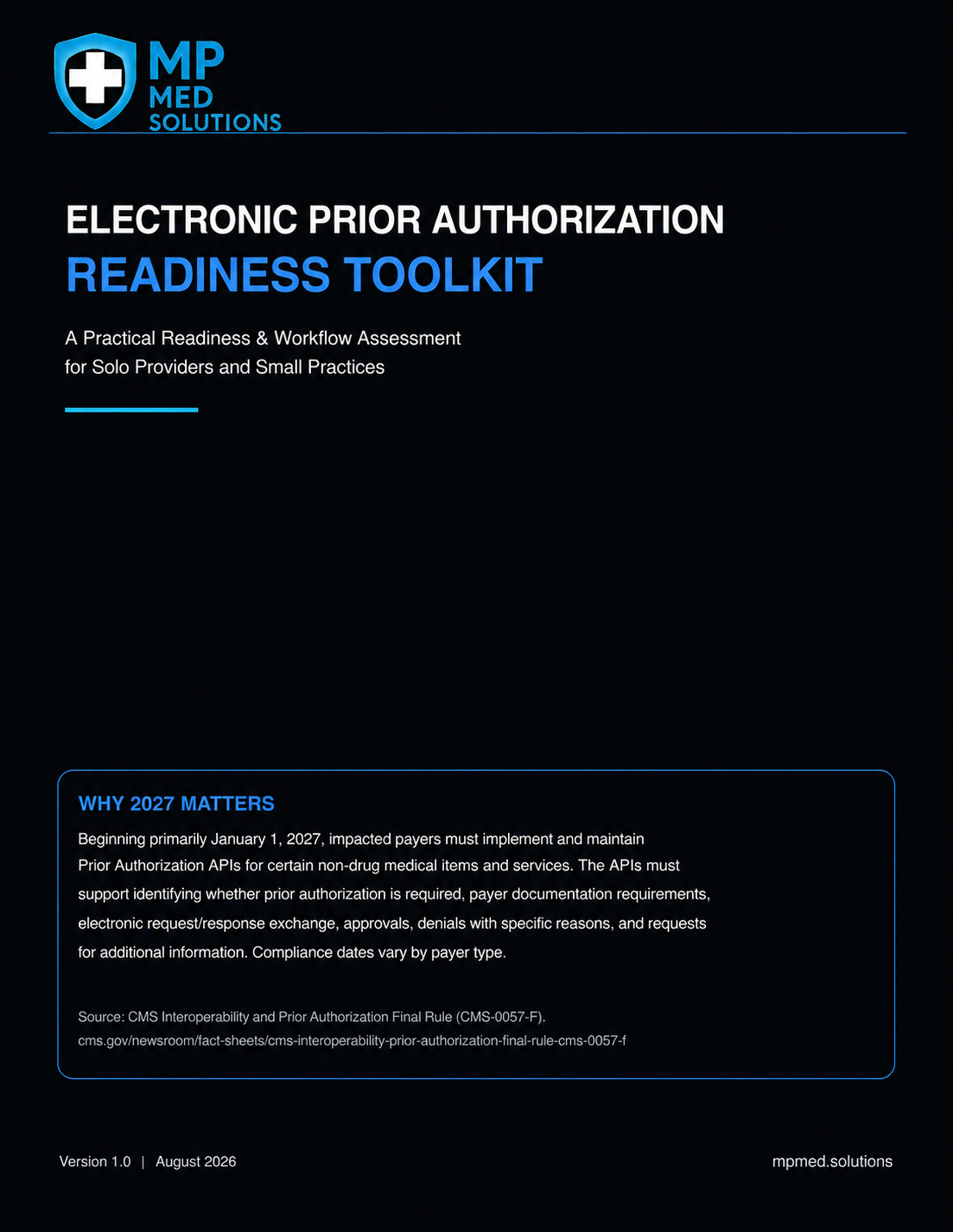
A Practical Readiness & Workflow Assessment for Solo Providers and Small Practices
Beginning primarily January 1, 2027, impacted payers must implement and maintain electronic Prior Authorization APIs under CMS-0057-F. That's a requirement on payers — not on you. Whether your practice can actually take advantage of it depends on decisions inside your walls: is your EHR vendor ready? Do you know where each payer actually stands? Does your team have a real plan for the day something fails?
This isn't another explainer telling you a rule exists. It's a 42-page, fillable operational workbook built to help you answer those questions honestly — and turn the answers into an action plan, not just an awareness of a deadline.
Technology readiness doesn't automatically create an efficient workflow. A practice can have full access to electronic prior authorization and still lose time to missing documentation, unclear staff ownership, payer inconsistencies, and poorly handled denials. This toolkit is built around that reality.
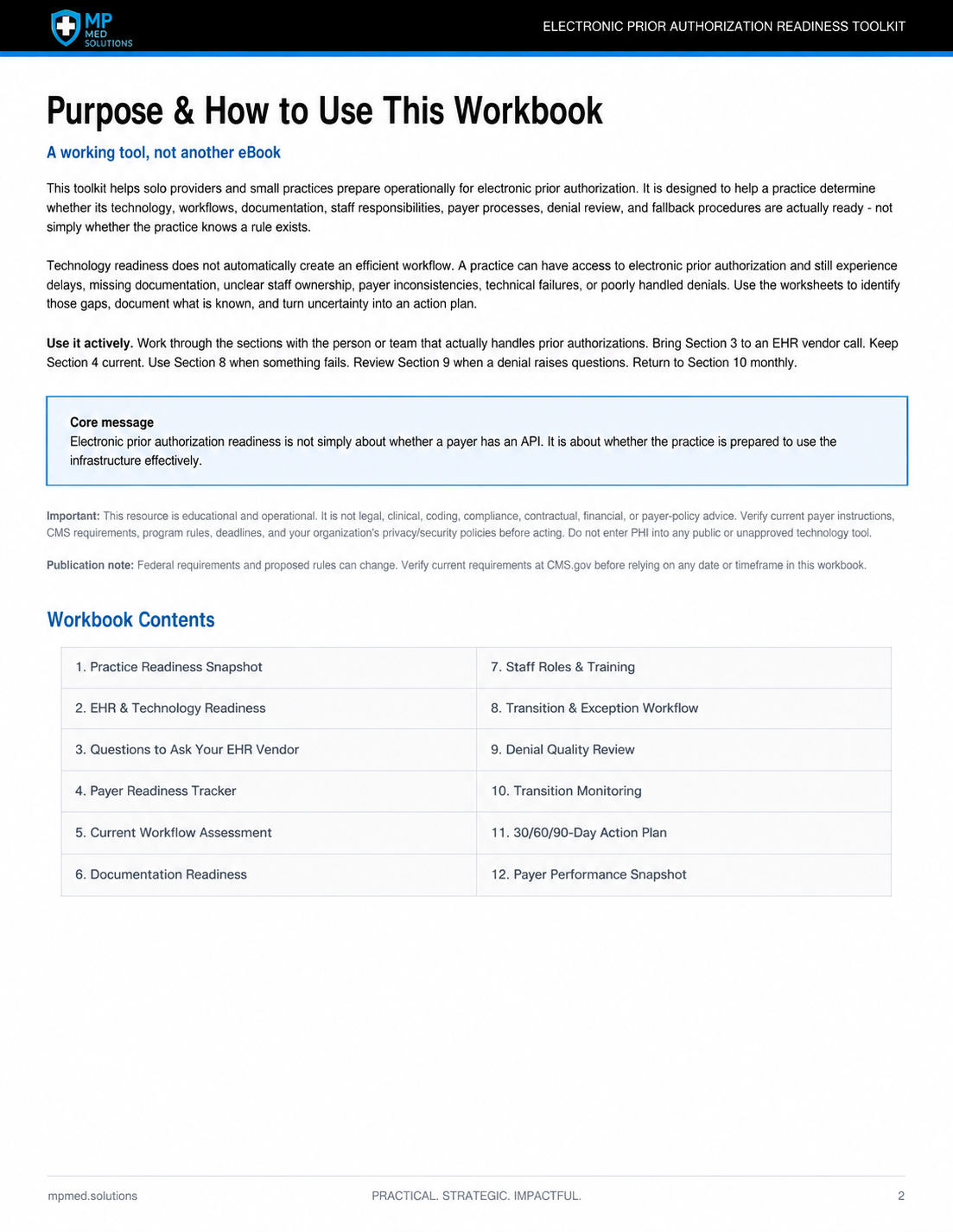
Eleven working sections, each designed to be filled out — not just read:
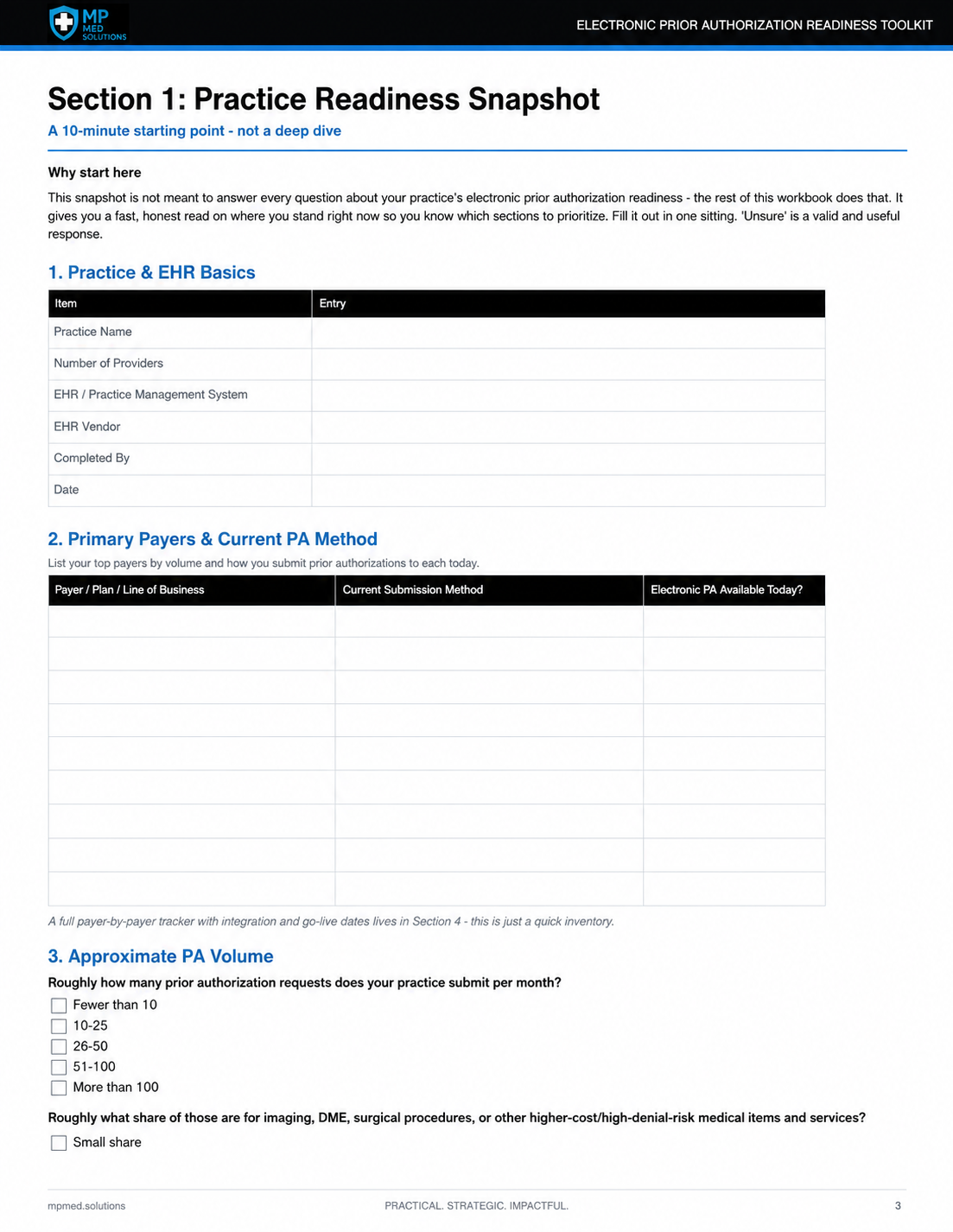
Practice Readiness Snapshot — a 10-minute starting point that tells you where to focus
EHR & Technology Readiness — a practice-side audit of what your system actually does today
Questions to Ask Your EHR Vendor — a worksheet built to take directly into a vendor call
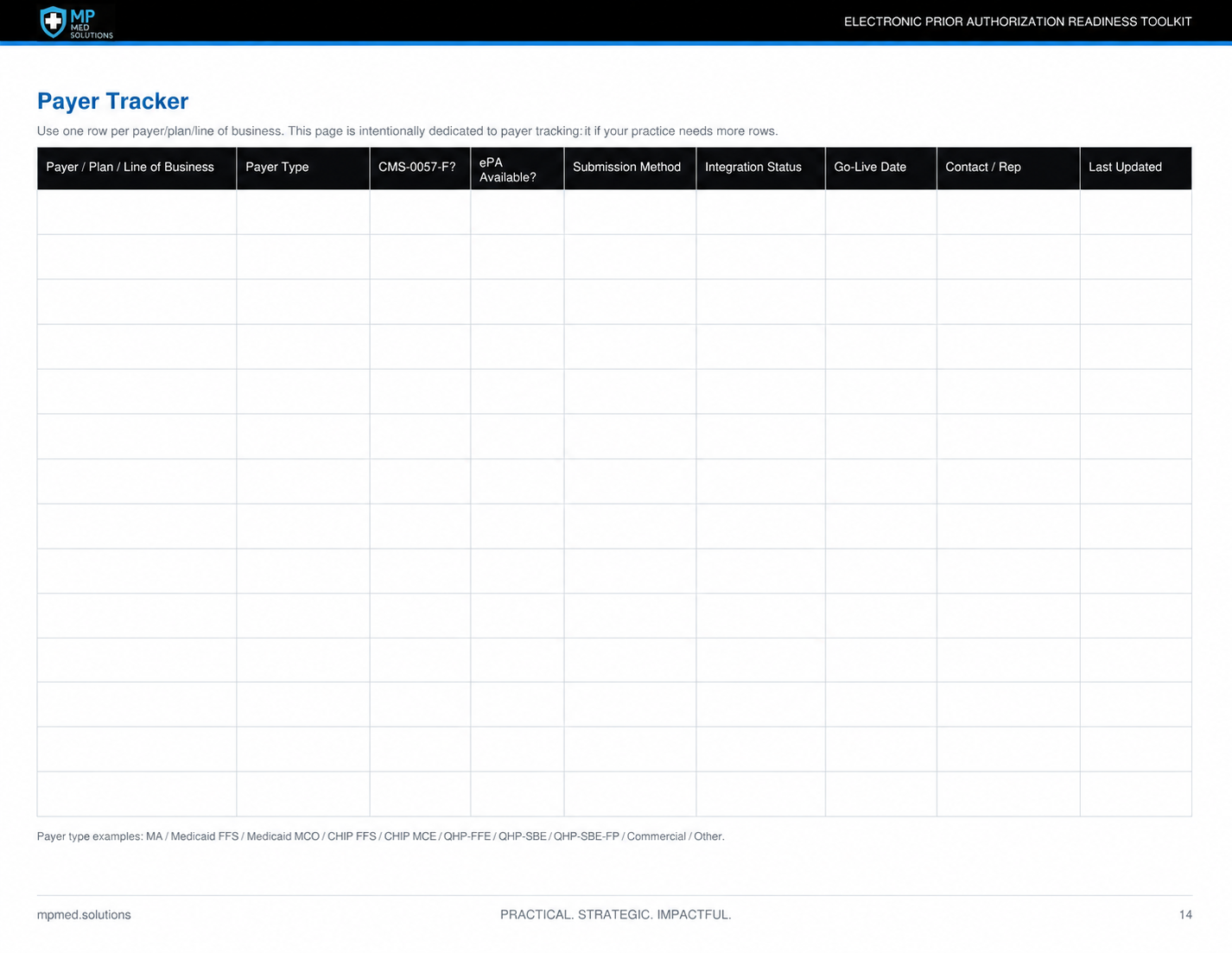
Payer Readiness Tracker — a living, payer-by-payer record of electronic PA status and go-live dates
Current Workflow Assessment — map what actually happens today, handoffs and all
Documentation Readiness — a quick check on where required documentation actually lives
Staff Roles & Training — turn "who handles this" into a documented plan with real backup coverage
Transition & Exception Workflow — your playbook for when the electronic process doesn't work
Denial Quality Review — a worksheet for reviewing not just why a request was denied, but how the denial was issued
Transition Monitoring — a monthly check on whether the transition is actually reducing work
30/60/90-Day Action Plan — turns everything above into a sequenced plan with a start date
Payer Performance Snapshot - compare payer-published prior authorization metrics with your practice’s own denial and turnaround experience
Sections 3 and 9 are the standouts — built to be strong enough to bring directly into a vendor call or a real denial dispute, not just fill a page.
Solo providers, practice managers, and billing staff at independent and small practices who need to move past "we know the rule exists" and into an actual operational plan — before the deadline, not after.
This is an educational and operational resource. It is not legal, clinical, coding, compliance, contractual, financial, or payer-policy advice. Regulatory requirements and timelines can and have shifted — always verify current requirements at CMS.gov before relying on any date in this toolkit.
Downloadable, fillable PDF. Type directly into it or print and complete by hand. Use it once as an assessment, or keep it as a living document — several sections (the payer tracker, the exception log, the monthly monitoring worksheet) are built to be revisited, not filled out once and filed away.
$39 | Instant Download
Electronic prior authorization readiness was never really about whether a payer has an API. It's about whether your practice is prepared to use the infrastructure once it exists
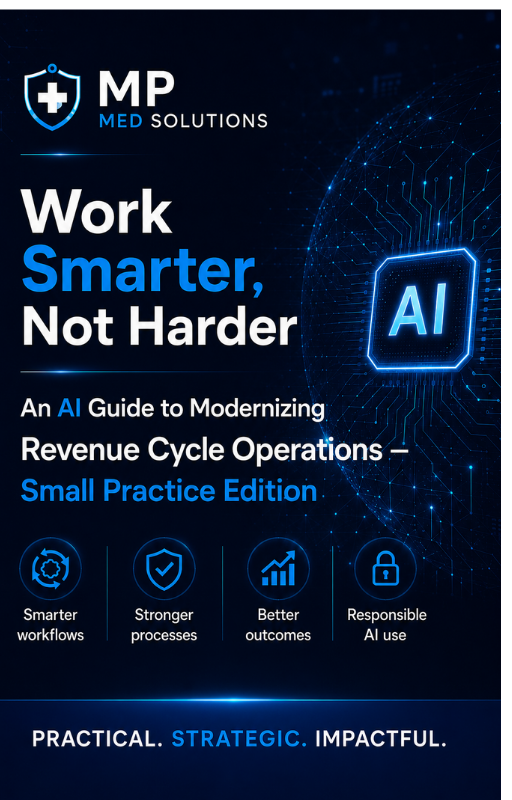
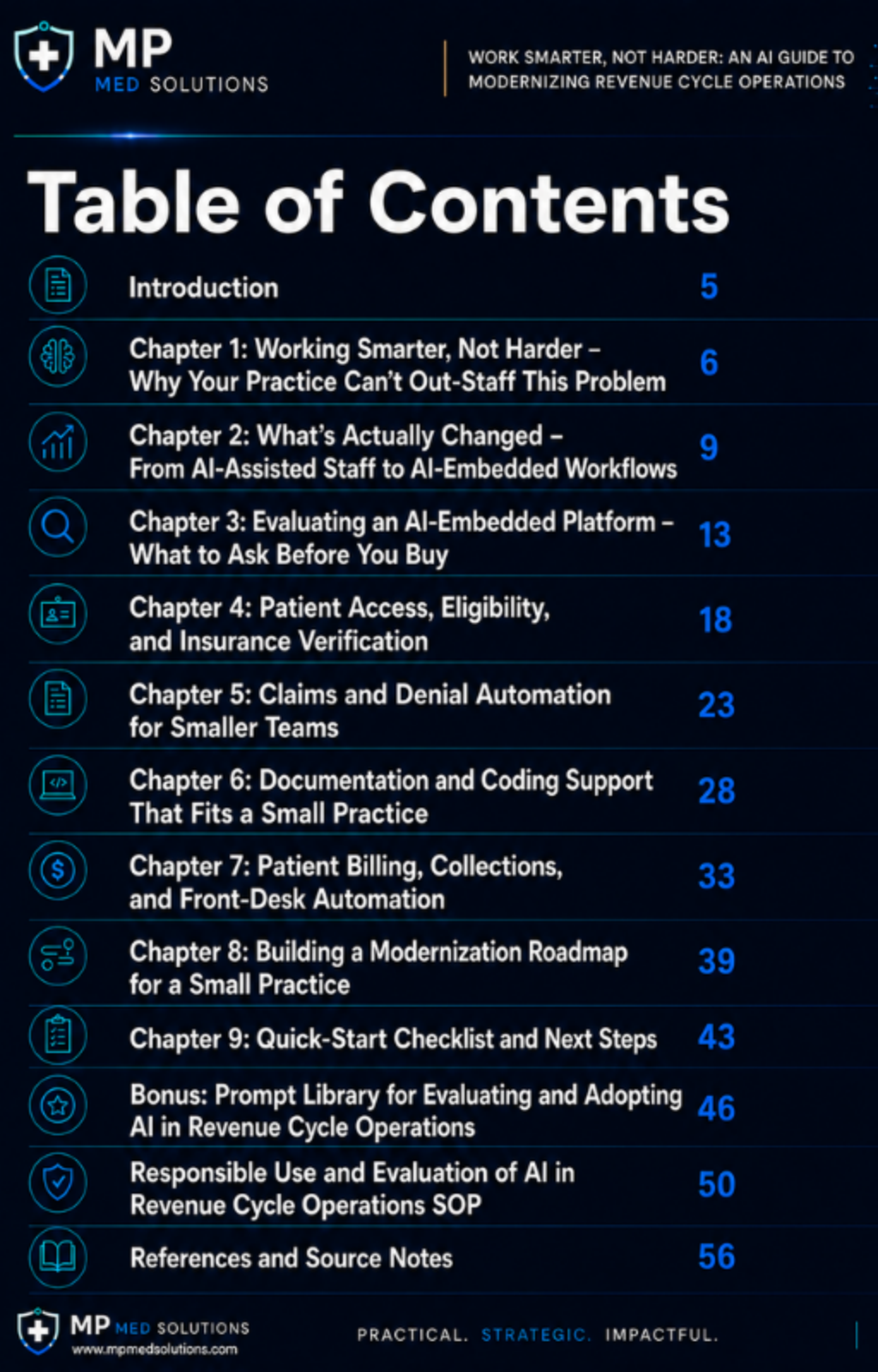
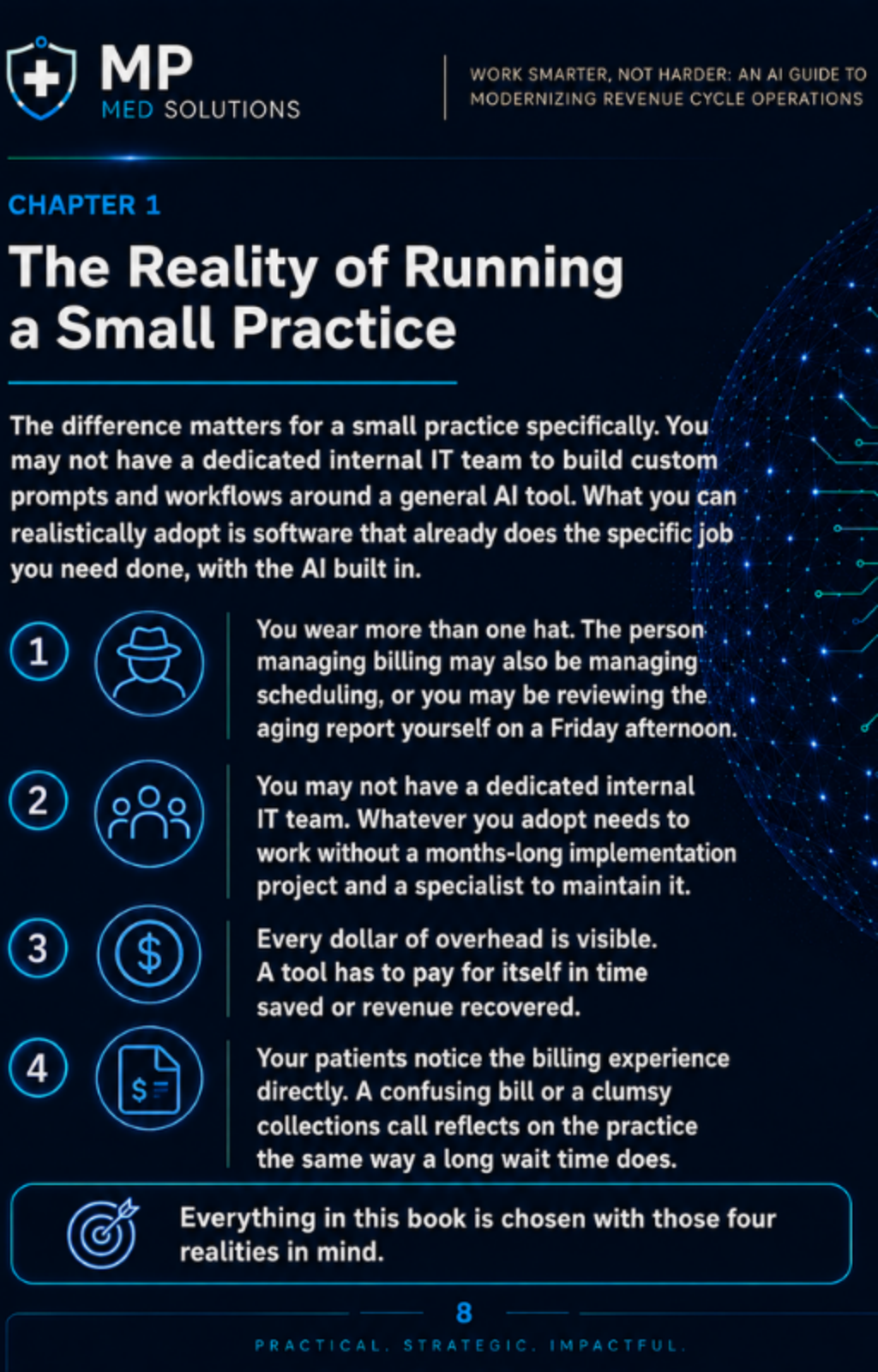
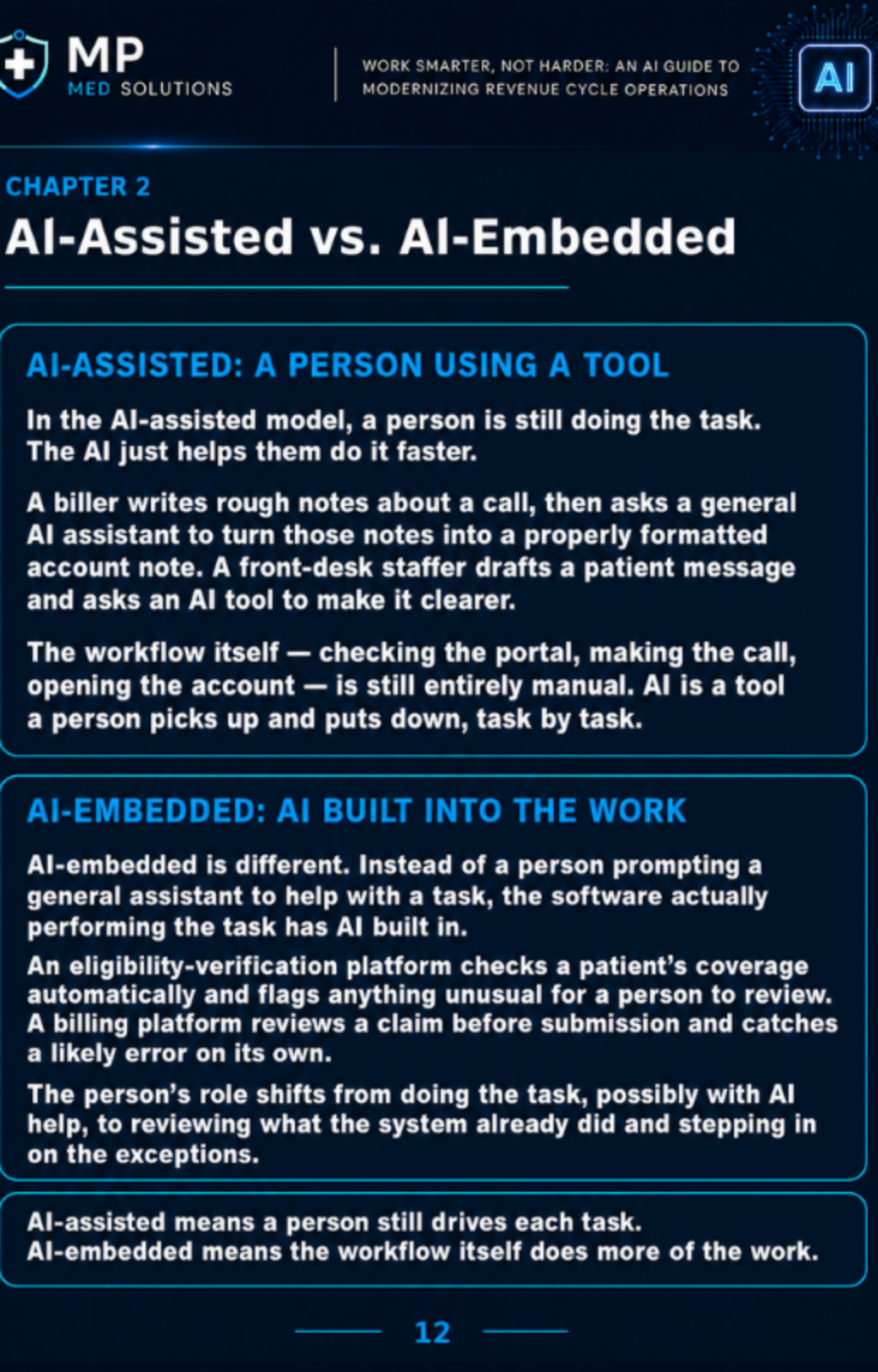
Work Smarter, Not Harder: An AI Guide to Modernizing Revenue Cycle Operations — Small Practice Edition is a practical, professionally designed guide created for practice owners, managers, billing leaders, and healthcare decision-makers who want to understand where AI and automation can realistically improve revenue cycle operations.
This guide goes beyond generic AI advice. It explains the difference between AI-assisted tasks and AI-embedded workflows, identifies common revenue cycle pain points, and shows how modern platforms can support eligibility verification, claims management, denial prevention, documentation, coding, patient billing, collections, and front-desk operations.
Inside, you’ll find:
Practical guidance for evaluating AI-enabled platforms
Questions to ask vendors before signing a contract
Small-practice workflow examples
Platform profiles and implementation considerations
HIPAA, data-handling, and responsible-use reminders
A modernization roadmap and quick-start checklist
A bonus prompt library and responsible AI-use SOP
This resource is designed to help small practices make informed technology decisions without getting lost in technical jargon, vendor hype, or solutions built primarily for large health systems.
Your purchase includes:
Access to the interactive page-turning flipbook
A downloadable PDF copy for permanent reference
Price: $59
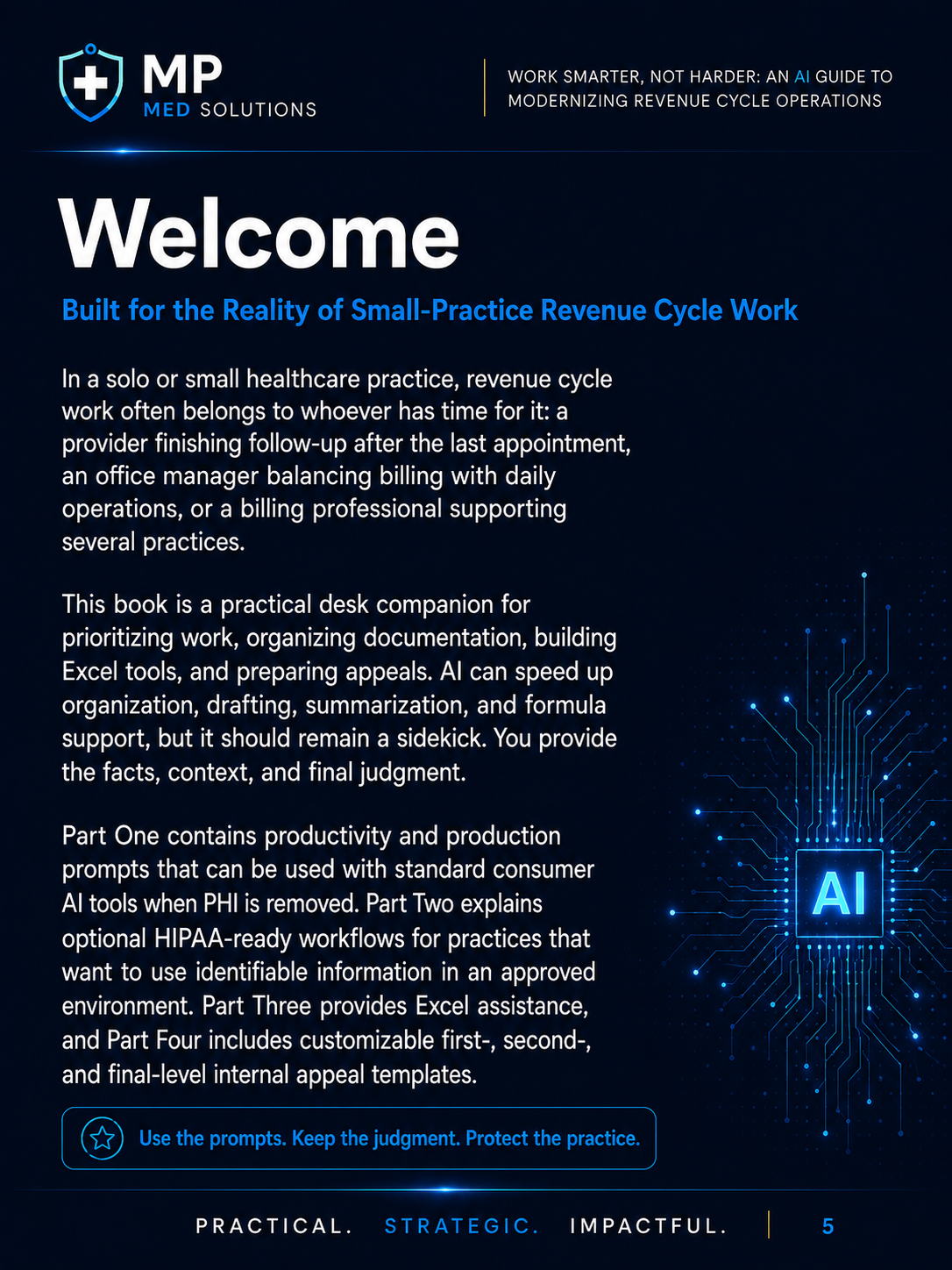
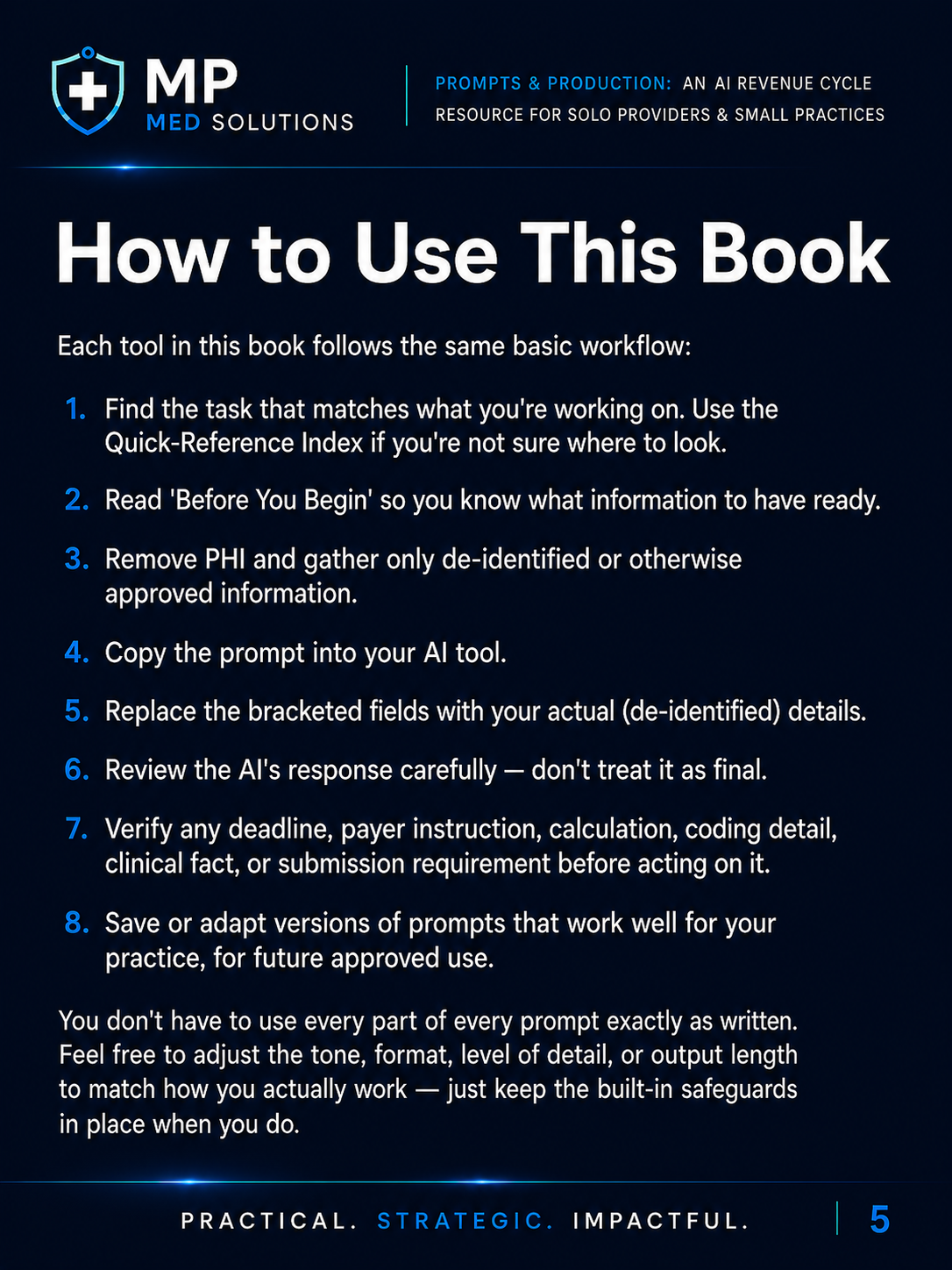
Prompts & Production: An AI Revenue Cycle Resource for Small Practices is a practical, ready-to-use resource designed to help solo providers, office managers, medical billers, revenue cycle staff, and other small-practice professionals handle everyday revenue cycle work more efficiently with AI.
Inside, you’ll find practical prompts, workflow guidance, Excel support, appeal letter templates, and tools for organizing work, prioritizing competing tasks, improving documentation, reviewing denial patterns, summarizing payer information, troubleshooting spreadsheets, and communicating more clearly.
Created specifically for the realities of solo and small healthcare practices, this resource focuses on real workflow needs—not generic AI advice. Each section is designed to help reduce repetitive work, improve consistency, strengthen productivity, and support better revenue cycle decision-making.
The guide also includes responsible-AI guidance, including when de-identified information can be used with standard AI tools and what to consider when working in HIPAA-ready environments.
Work smarter. Protect revenue. Strengthen the workflow.
No results match your search. Try removing a few filters.